

📌 Module 9: Climate Survey ✨
The Climate Survey is one of the tools we have available in HR to understand how people feel within our organization. It allows us to understand employees’ perceptions of our organizational culture.
Its main purpose is to provide an honest snapshot of our work environment, enabling us to take actions that bring about real changes and contribute to the well-being of our staff and the company’s competitiveness.
It is essential that, if we decide to implement this tool, we uphold the essential principle of the survey, and that is our survey must be completely anonymous and not subject to retaliation. Our mission is to commit to improvements, even when the results are unfavorable.
Therefore, if, as an organization, we are not prepared to analyze the results, the most appropriate course of action is to wait until we are ready to implement it. Sometimes the honest answers can make us uncomfortable, so we will require courage and maturity to be open to what the survey is unveiling us.
🎯 Goal of the Climate Survey
The survey, as we mentioned earlier, grants us the opportunity to understand how employees consider our company. Some of the topics we can identify are:
- Determine the level of satisfaction and engagement.
- Identify practices that motivate.
- Identify problem areas that may affect retention.
- Analyze the quality of leadership at different levels.
- Evaluate the effectiveness of internal communication.
- Understand how the company’s values are lived in practice.
- Measure how spaces, tools, and working conditions are perceived.
We will transform the results into concrete actions that foster motivation and continuous improvement. For this purpose, it will be necessary to create a questionnaire that provides us with the data we’re looking for.
🦹♂️ The importance of anonymity
Ensuring anonymity is the crucial pillar for obtaining honest responses in our survey.
If people feel that they can be identified with their answers, maybe they won´t be critical when answering, they won´t express themselves honestly, or they may decide not to participate. Even worse, if at any point in a previous version we come across a response we don’t like and use it to sanction or single someone out, we’ll end up breaking trust in the process.
Therefore, as HR, we must ensure:
- Identities will not be tracked.
- Do not request unnecessary data in the survey.
- Do not require mandatory participation.
- Do not link responses to performance evaluations.
- Do not penalize areas with low participation.
Yes, it’s possible that distrust may arise if we ask for categorization data, such as age, tenure, or department. The truth is that this data is essential to identify the problems in each department more precisely. Therefore, if a department consists of only a small number of people, employees often suspect that it’s obvious for us to know who the staff members are. Therefore, it is advisable in this ocasions not to show this information to managers.
🧩 Methodologies for conducting the survey
Here are different methods for assessing the work climate. Some will be more effective than others, and at times they will depend on the level of trust and the company’s culture:
-
Anonymous survey (recommended) 😉
It is the most widely used and recommended option, as it provides more representative data. It can be performed internally (created by HR) or through an external provider to reinforce anonymity.
-
Focus Group
We create small groups to discuss specific topics. Its biggest disadvantage is that it doesn’t foster anonymity and can create social pressure or fear of speaking up. It will largely depend on our organizational culture.
-
Interviews with managers
In this case, managers may be responsible for conducting interviews with their staff. The biggest risk is that people probably won’t want to express sensitive issues in front of a superior or someone below.
-
Hybrid method
Anonymous survey + interviews to delve deeper into some results. We combined the methods above.
The method we choose will be subject to the following factor: encouraging honest responses. If we have a healthy culture, interviews or focus groups will be highly effective, and managers will get the results right away. It’s ideal for small companies. While in large companies, the best approach is an anonymous survey, as it will allow us to reach most of the staff.
Another factor we must consider when choosing a method is time. Conducting surveys or interviews takes up time that we take away from their daily tasks.
🎨 Designing the survey
When designing the survey, it is essential to be meticulous and specify clearly the topics we want to address. Here are some recommendations to consider when creating the questionnaire: 😉
-
Define what we want to measure => with the climate survey, it’s advisable to focus on the following areas:
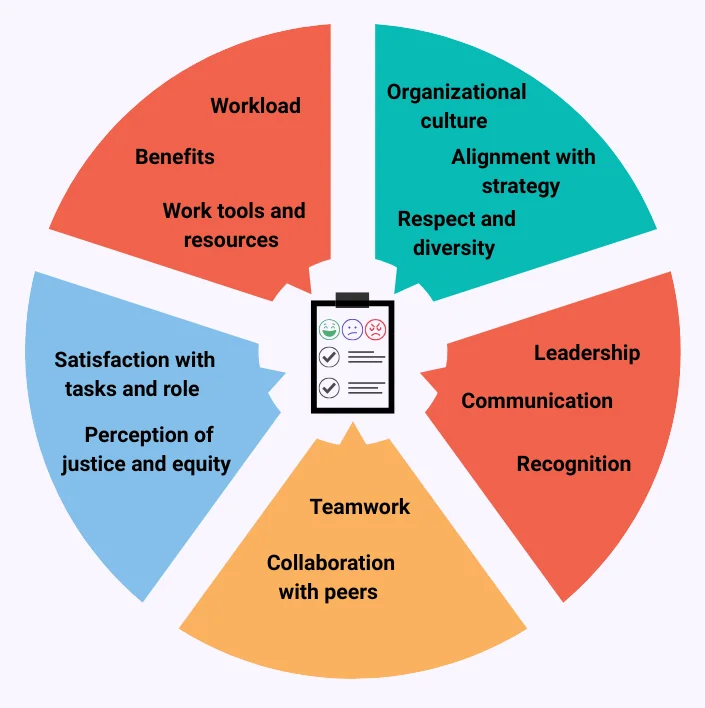
We can focus on covering all or just some of the topics. The focus will depend on whether we want to address a specific topic or on the number of questions we intend to have in our survey.
-
Clear and simple questions => it is important to avoid technical terminology or ambiguous questions whenever possible. Employees may confuse, which could lead to obtaining incoherent results. Sometimes we ask the same, but with different tones, without knowing
🤓TIP: Once you’ve formulated the questions of the survey, ask a teammate to try to answer them and check that they’re easy to understand.
-
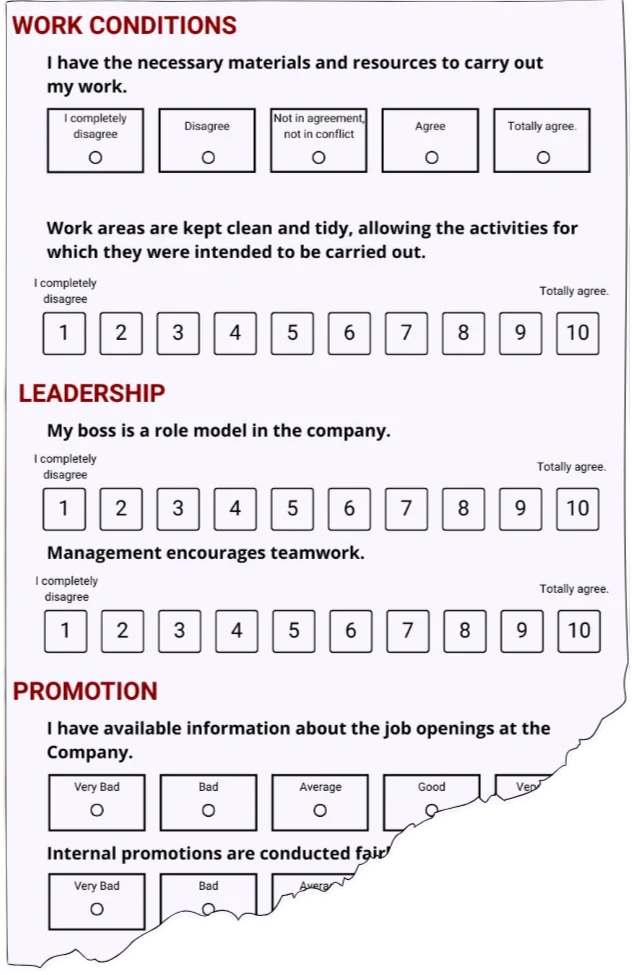
Standardized scales => we can focus on YES or NO questions, or on the scale ranging from Poor to Excellent. If our goal is to calculate ratings, scales from 1 to 5 or 1 to 10 are also a valid alternative. The crucial thing is that, when converting the responses into data, we obtain the information we’re looking for.
🚨 It is essential to be careful with scale questions so that they do not become a yes/no assessment. It will affect our results.
-
Avoid long surveys => they should be completable in 10 to 15 minutes at most. A questionnaire that feels lengthy can lead people to respond automatically just out of obligation.
-
Include a space for comments => it’s a good option if we want to get an “extra” from some of the questions.
🎯 It is recommended to reserve 1 or 2 questions for free responses. Especially to capture any aspect we haven’t managed to cover with the survey.
-
Consider the timing and setting => ideally, responses should be submitted during working hours. We must provide a space that guarantees anonymity and is free from pressures.
💻 Nowadays, technology offers us enormous advantages; an online survey can be answered from anywhere and provides each person the convenience of responding at their most suitable time.
❌ Common mistakes to avoid
We will focus on a couple of practices that can sabotage the validity of our data.
- 🔸Rewarding areas for a higher participation => we can incentivize dishonest responses or even people responding for others because the survey is anonymous. It is preferable to foster participation through communication and genuine engagement.
- 🔸Making the survey too long => could cause individuals to get tired of responding and select options in the questions only to finish quickly. This will reduce the quality of our information.
- 🔸Asking for sensitive data that could identify individuals => remember that anonymity is our cornerstone; ensuring it is crucial. While we use categorizations, we must ranges.
- 🔸Not communicating results => we avoid distrust. Presenting the survey results makes employees realize that we value their opinions and the time they spend responding.
- 🔸Not implementing action plans => a survey without action destroys our credibility. Even if it’s only a minimal action, it’s better to act than to do nothing. However, the action must be meaningful.
🤔 How do we interpret the results?
It’s time to interpret the results of our survey; we must analyze them rigorously, prudently, and without bias. As the HR department, we must:
- Identifying clear trends, they will guide the action plans. With isolated cases, we must monitor them and determine whether they are urgent or not.
- Compare areas. Remember that in departments with only a few people, we must protect their anonymity.
- Analyze results with the responsible managers. With them, we will determine which issues require more attention than others.
- Connect data with People Analytics metrics.
- Identify improvements compared to previous years. Comparing the data will help us understand if the action strategies implemented in previous years were appropriate.
We will be able to group our data into the following:
- Cultural Strengths
- Areas to Supervise
- Critical Issues
This is where dashboard creation (with pie charts, bar graphs, and averages by dimension) becomes relevant; they simplify the process of communicating results to the entire company.
📣 Communicating the results
As I have mentioned previously, transparency in communicating the results will be the foundation of credibility in our process. It is recommended:
- Prepare and present a summary sheet with the most relevant indicators.
- Communicate both the good and the bad.
- Deliver a simple, clear, and accessible presentation.
- Give thanks to our employees for their participation in the survey.
- DO NOT incorporate the action plans yet.
🪄 Action Plan
We are now starting the process of designing and implementing the action plans. Don't forget that they must be supported by the data of the surveys. The action plans may be:
- Cross-functional => they apply to the entire company. For example: improving the cafeteria, internal communication, benefits, or ergonomics.
- Area-specific => apply when a department faces a particular issue. For example, improving teamwork in the sales department, communication in the production department, or leadership in the logistics department.
- Hybrids => a combination of both. For example, improving internal communication across the company and the way HR communicates.
🗝️ Key recommendations:
- We must develop the plans together with the managers.
- Prioritize actions based on impact and feasibility.
- They must be realistic and measurable.
- Assign a clear responsible for each action.
- Establish realistic deadlines.
- Communicate the action plan to the entire organization.
- Incentives can be included when real improvements are achieved.
😉 TIP: Sometimes it’s best to focus on the small things rather than the big ones. For example, we’ve noticed a few minor complaints about the food; finding ways to offer healthier meals benefits more than just a few people.
♻️ Continuous monitoring and improvement
To recap, the climate survey is not an isolated event but part of an annual cycle in which we go through the following stages:
- Survey planning and design.
- Communication
- Execution
- Analysis
- Communication of results
- Action plan
- Follow-up
- Final evaluation
- Redesign and start over next year.
For the finale, the Climate Survey is a transformative tool that we must implement with seriousness and transparency, but above all, centered on the people in our organization.
It not only provides us with useful information, but it also helps us to strengthen culture and trust, drives employee engagement, contributes to their motivation, and enables the company to progress year after year.
👉 Its true strength lies in listening to people and acting accordingly. 💪
🧠 Practical exercises
👉 Exercise 1 – Internal Reflection
Think about your current company or one where you've worked:
- What signs did you observe that indicated there was (or wasn’t) sufficient trust to conduct a climate survey?
- How do you think people would react if they received a survey tomorrow?
- What fears might they have?
Objective: Identify cultural barriers before implementing the project.
👉 Exercise 2 – Preliminary Diagnosis
Before designing the survey, answer:
- Which three cultural dimensions do you think are most necessary to measure this year?
- Why?
- What impact would improving each of them have?
Objective: prioritize strategic dimensions.
👉 Exercise 3 – Applied
Design a short micro-action plan based on the following scenario:
The plan must include:
- A cross-cutting action.
- A specific action for a particular area.
- A simple indicator to measure whether they have improved.
- A reasonable timeframe for evaluating progress.
Objective: practice translating data into concrete actions.
🪄 Extra
Below is an example of a timeline we can follow for our Climate Survey Plan. They don’t necessarily have to start in January; you can use the beginning of the fiscal year. The important thing is that you don’t forget to design it; it will help you set deadlines for each stage.
🗓️ Example of an Annual Climate Survey Schedule
📍January – Planning
- Define the year’s objectives (what do we want to measure and why?).
- Review the results of the previous year.
- Adjust or redesign the survey.
- Define indicators, scales, and categories for analysis.
- Align expectations with directors and managers.
📍February – Project Preparation
- Selection of methodology (internal survey or external provider).
- Setting up technical support (form, platform, access).
- Drafting the internal communication plan.
- Brief training for managers on how to support the process.
📍March – Prior Communication
- Launch the communication campaign: email announcements, posters, meetings, and intranet.
- Reminders of the 100% anonymous nature.
- Clear explanation of the objective and benefits for staff.
📍April – Survey execution
- Send the form to all staff.
- 1–2 weeks to respond.
- Sending gentle reminders (without being pushy).
- Be prepared for technical support for anyone who needs it.
📍May – Processing and Analysis
- Review of participation by area.
- Data cleaning and validation.
- Analysis by dimensions (leadership, communication, culture, etc.). Identification of strengths and critical points.
- Preparation of simple dashboards and charts.
📍June – Results Presentation
- Presentation to Directors.
- Presentation to managers.
- Communication to staff (executive summary).
- Thank all for their participation.
📍July – August – Action Plan Design
- Workshops with managers and HR to prioritize issues.
- Definition of cross-cutting and individual solutions.
- Selection of responsible parties and deadlines.
- Approval of budgets, if applicable.
📍September – Implementation of the Action Plan
- Inner launch of the plan.
- Transparent communication of the measures that will be taken.
- Start of the formal activities and planned changes.
📍October – November – Follow-up
- Monitoring meetings with managers.
- Short surveys to measure progress (optional).
- Adjustments if deviations are detected.
📍 December – Year-End Closing
- Impact evaluation of the actions taken.
- Recognition of areas or teams with outstanding improvements.
- Documentation of lessons learned and suggestions for next year.
- Communicate to the company that the process has come to an end.