

🧩 Module 2: Organization Chart
We have already learned about the policies that provide a framework for our company, now it is time to focus on its internal structure. And here appears a fundamental tool: the Organizational Chart.
📅 What is an Organization Chart?
It is a well-known chart that illustrates how a company is structured, detailing the areas involved, their relationships to one another, and the hierarchical levels each position occupies. It is, quite literally, the skeleton of our organization.
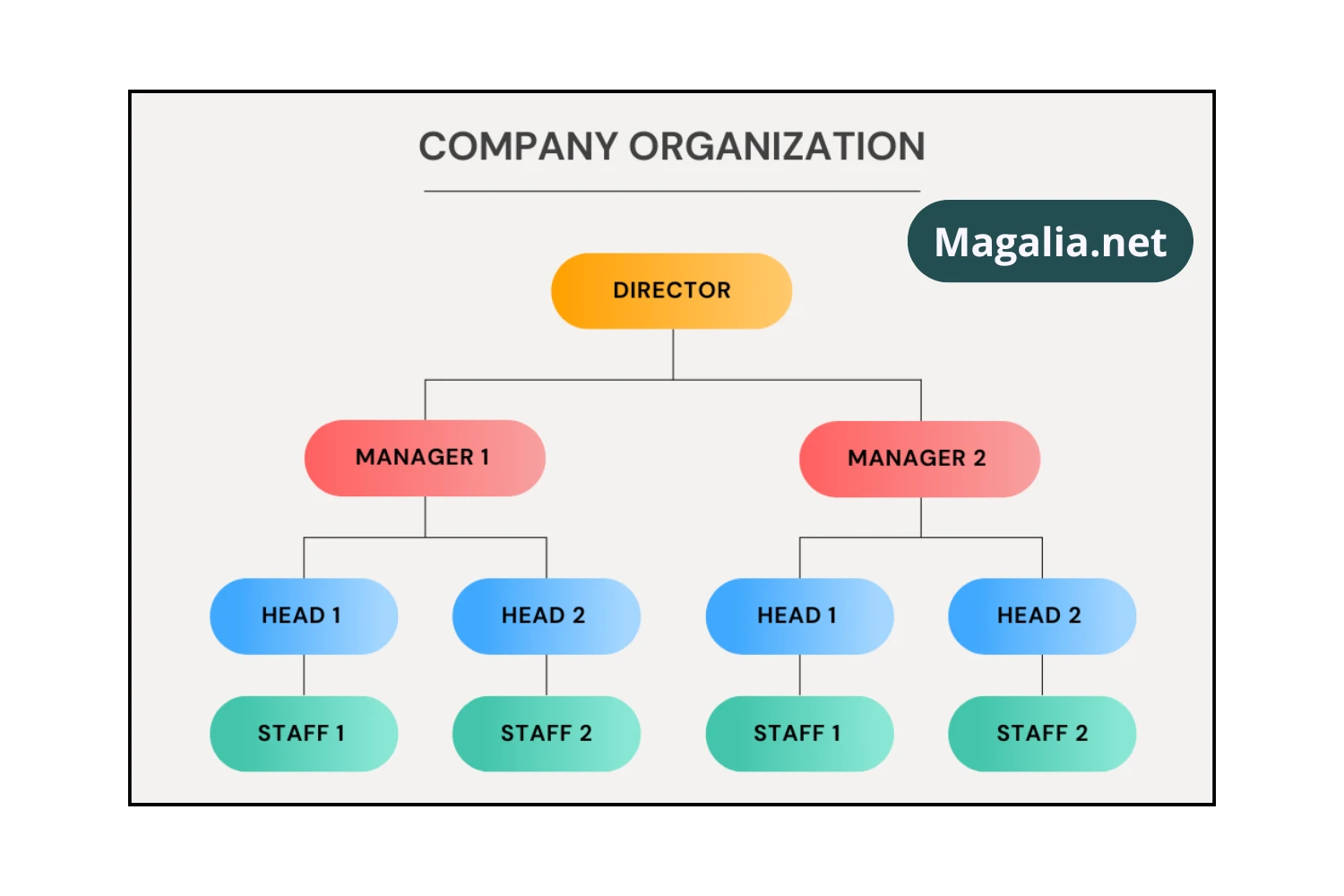
A good organizational chart shows:
- The internal hierarchies.
- The departments that comprise it.
- The possibility of mobility (promotions or sector changes).
- The connections between areas.
- And furthermore, it serves as a basis for creating a replacement chart.
⚠️ Why is so important?
📌 Because it organizes and provides clarity. For example, if you start working at a new company and you see its organizational chart, you already know who your direct boss is, who is in charge of each area, and how the entire system is connected.
📌 Because it facilitates communication. The clearer and more detailed it is, the easier it will be to understand how the information flows and who decides what.
📌 Because it is not static: organizational charts must be updated whenever a position is added or modified. Let's remember that companies adapt, transform, or evolve.
📝 How can we start creating an Organizational chart?
Here are some points you can apply to create your organizational chart:
- List all the positions that exist in your company (yes, all of them. You'll understand why later).
- Identify hierarchical relationships (who reports to whom).
- Choose one of the types of visual structure that suits your organization.
- Draw it and then... Check it!
- Remember that there can be a general organizational chart and smaller organizational charts by department. It will make it simpler and more organized.
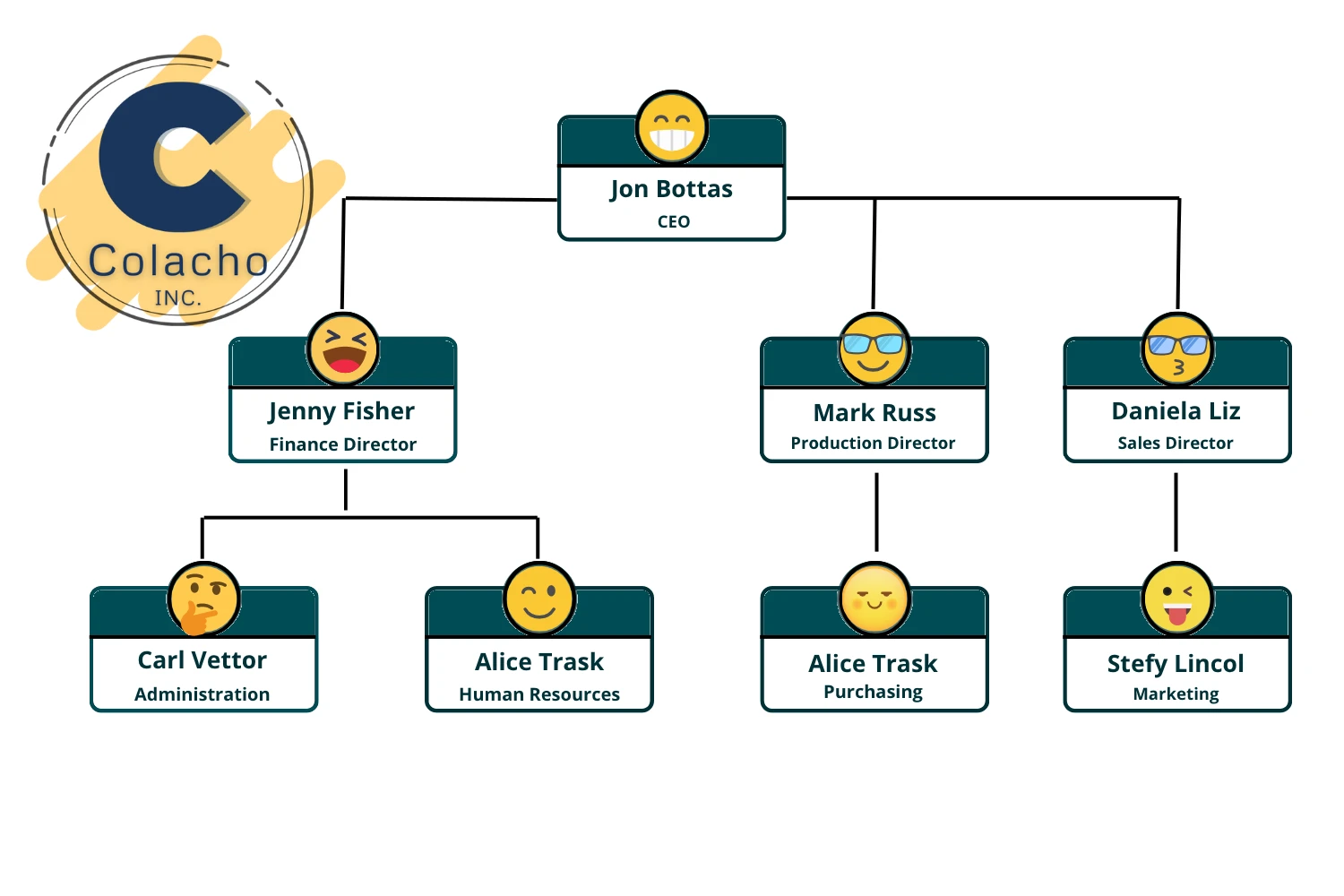
💡If you're in a start-up, don't postpone it. The bigger the company gets, the harder it will be to build it from scratch. The process may turn out to be a "Herculean" one, but believe me, giving it the importance it deserves will be of great benefit to us in the future.
🧭 Types of Organizational chart
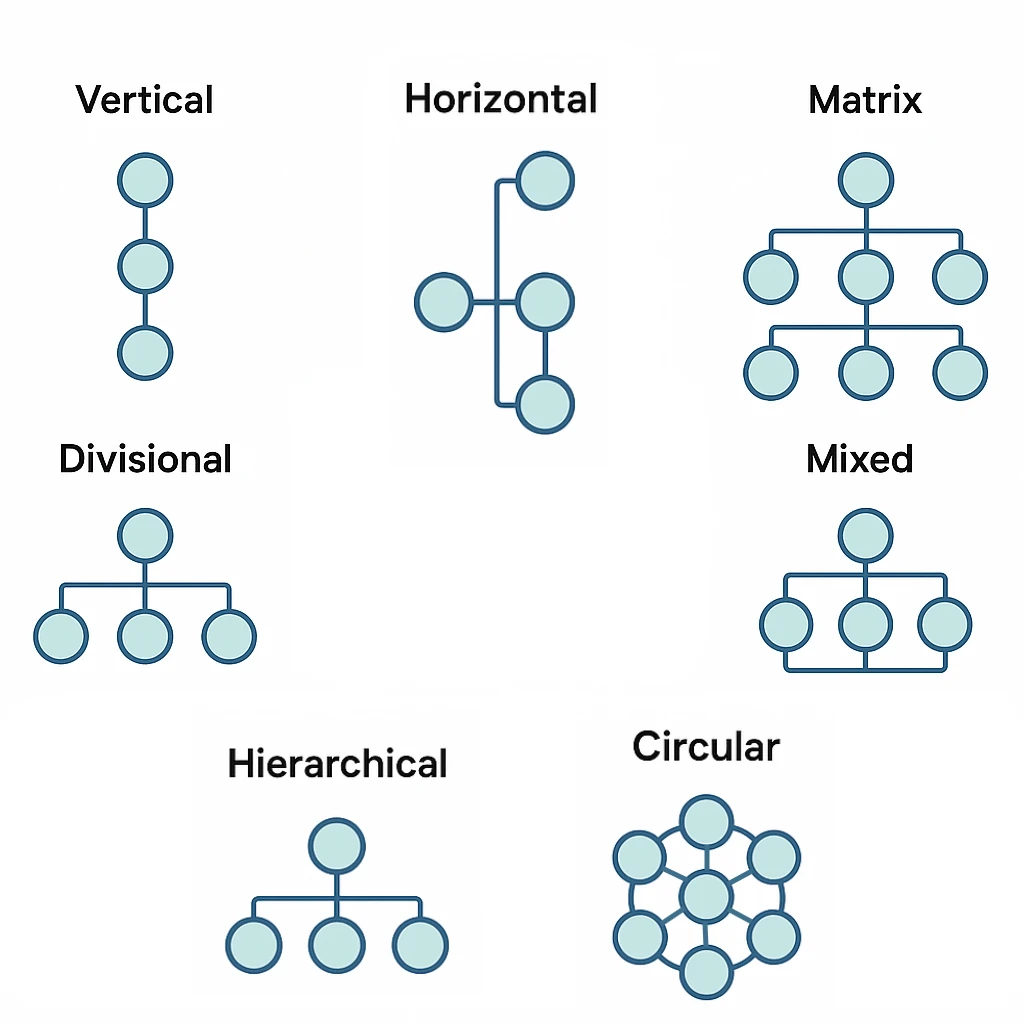
When we create the Organizational Chart, we will be able to categorize it within the following types:
-
🔺 1. Vertical Organizational Chart => It is the most common. It shows the hierarchy from top to bottom, starting from the CEO, we will go down through the levels of hierarchy until we reach the operational positions. Ideal for companies that are just starting out or a simple representation of our company's structure.
-
🏢 2. Hierarchical Organizational Chart => Designed in tiers according to rank (we emphasize hierarchy). The connections flow from a central starting point and branch out.
-
🔗 3. Matrix Organizational Chart => Combines two structures: a vertical one (by departments) and a horizontal one (by projects). It is used in companies with subsidiaries or project teams. Attention! Here we have dual management, we will be forced to achieve good communication between the involved parties and thus avoid conflicts between the department head and the project leader.
-
🧩 4. Divisional Structure => Shows the different departments under the same CEO. Each block (Sales, Finance, Production…) has its own team. It is vertical, but grouped by functions. This type of organizational chart makes it easier to break down the company's structure into different "divisions", each with its own autonomy, having its own departments for the development of the product for which they are responsible. It allows for more adaptable and decentralized management.
-
⬅️➡️ 5. Horizontal Organizational Chart => Instead of going from top to bottom, it goes from left to right. Useful for representing structures with less hierarchy. With this organizational chart, the company is structured by prioritizing collaboration between departments; it is vital to achieve fluid communication among them. The teams achieve greater autonomy, managing themselves.
-
🔀 6. Mixed Organizational Chart => First divide by large areas (for example: Administration, Production, Marketing), and then show the hierarchical levels within each one. It allows us to create an organizational chart composed of others, helping us better recreate the structure of our company. Very useful in companies with many divisions. We will be able to observe the chain of command and the relationships between departments.
-
⭕ 7. Circular Organizational Chart => The most creative! It places the central authority in the middle, and the other departments are distributed around it. It goes from the inside out and promotes a more inclusive vision. It is ideal for representing an enterprise.
✏️What can we achieve with a good organizational chart?
When we develop the organizational chart, we must keep in mind the following benefits that we obtain from it:
- Detect failures in our organizational structure. Especially in the duplication of roles or tasks.
- Improve the distribution of responsibilities. That there are no imbalances in authority.
- Keep the staff informed about the structure. Everyone knows their position and the growth opportunities.
- Anticipate changes or expansion needs. New skills that positions acquire or the need to create new ones.
⚠️ A few limitations to consider
Even achieving an organizational chart that most accurately represents the structure of our company, we may still encounter the following issues:
- It does not always reflect all informal or real work relationships.
- It doesn't show leadership styles or management methods.
- In dynamic environments (like start-ups), it can become outdated quickly, which is why it's crucial to have a review frequency.
✅ In Conclusion...
The organizational chart is not just a pretty drawing: it is a management tool. It allows us to give shape to the invisible, structure what happens within the company, and think strategically. We can create it for informational purposes, to generally showcase the company's structure. Or for analytical purposes, when we consider analyzing the company's structure. Therefore, when it is done well, it helps everything flow better. And like everything in HR, it's not just about knowing, but about knowing how to apply it. 😉
✍️ Proposed Activity
👉 Exercise 1: What Organizational Chart Would You Use?.
Below are three fictional companies. Your task is to briefly analyze each one and decide which type of organizational chart would be most appropriate to represent its structure. Explain why you chose that type and what advantages it might offer in this context.
🏢 Company 1: Comida Express
- A national fast-food chain with 18 locations across different provinces.
- Each location has a manager, kitchen staff, and front-of-house team.
- The head office includes departments for marketing, purchasing, HR, operations, and finance.
🛍️ Company 2: Moda Prisma
- A fashion company that works on a project basis. Each season they launch a new collection.
- Key areas involved: design, production, sales, logistics, and marketing.
- Each project (collection) is led by a project manager coordinating with area leaders.
🧬 Company 3: Biotech Sur
- A tech company based in Argentina that develops medical solutions.
- It has three main divisions: Research, Product Development, and Commercialization.
- Each division operates with autonomy and has its own leadership team.
🔍 Instructions:
- For each company, choose the most suitable type of organizational chart: vertical, hierarchical, matrix, divisional, horizontal, mixed, or circular.
- Justify your decision with a short explanation.
- You can use a table format or write your answers in paragraph form—whatever works best for you.
👉 Exercise 2: Draw an Organizational Chart
Imagine you’ve been hired by a small family-owned industrial maintenance company that is growing and needs to organize its structure.
Here are the existing positions:
- 1 General Director
- 1 Operations Manager
- 1 Administrative Manager
- 3 Technicians
- 1 Purchasing Lead
- 1 Human Resources Lead
- 1 Administrative Assistant
🎯 Your task:
- Draw an organizational chart representing this structure.
- Organize the positions by hierarchy level.
- You can sketch it by hand, or use simple digital tools like Canva, PowerPoint, or pen and paper if you're practicing.
- Optionally, propose one improvement for the future (e.g., adding a technical coordinator or splitting administrative duties).