

📌 Module 6: Performance Evaluation and Management

Perfect, we’ve successfully onboarded the new employes; now it’s time to manage and evaluate their performance to see how they’re doing, support them in achieving their goals, and keep them motivated so they can carry out their tasks. Therefore, in this module we’re going to focus on how to manage and evaluate performance. Let’s get started! 😊
🌟 Introduction
The management of the performance evaluation is a key process for measuring and improving the performance of employees, departments, and the organization as a whole. More than a control system, it should be understood as a tool for planning career development, aligning objectives, strengthening organizational culture, and motivating employees. 🤟
A good performance system helps us to:
- Plan objectives at the beginning of the year.
- Align individual goals with organizational goals.
- Identify strengths and areas for improvement.
- Facilitate professional and career development.
- Define fair rewards and recognition.
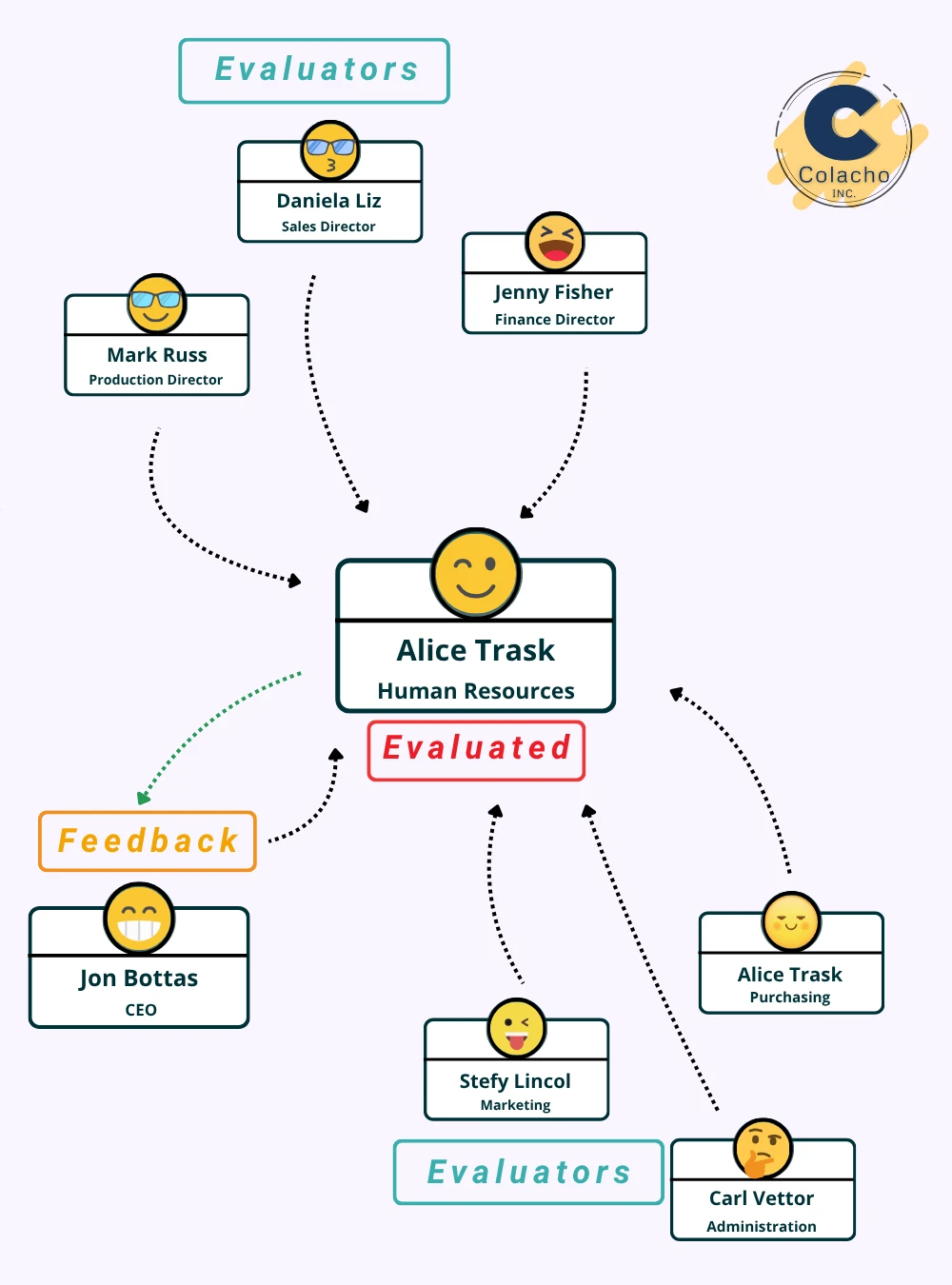
We must keep in mind that when we think about evaluating performance, we’ll encounter one person being evaluated and another who will be the evaluator. We can’t plan a performance evaluation if we’re not going to give feedback to our employes afterward.
🎯 Objectives of performance management
When managing employe performance, we must consider certain aspects that will facilitate the success of our management. Let’s get to know them. 👇
-
Establish an annual framework for planning and measuring objectives => which we will then break down into micro-objectives to make the task easier. In addition, it enables us to set deadlines, which will help us manage deviations if they occur.
-
Ensure coherence between individual, departmental, and organizational objectives => Ensure everyone is on the same page to prevent conflicts of interest.
-
Identify weaknesses in performance => This will allow us to see whether the person is struggling due to a lack of knowledge or for personal reasons.
-
Support career and training planning => If in the previous step we identified a lack of knowledge or skills, we’ll use the crucial points from that step to plan training (which we’ll cover in the next module).
-
Providing objective data for compensation, promotion, or recognition decisions => Being able to generate equitable and fair incentives for everyone is another essential aspect of having effective performance management.
♻️ The Performance Management Cycle
We must understand performance management as a continuous process, which we must establish year by year. The following four phases will describe and guide our performance evaluation process:
-
Planning
Our performance evaluation plan must be aligned with the mission, vision, values, and annual business plan.
Next, it will be necessary to establish the organization’s goals and, in accordance with these, define departmental and individual objectives. The relationship should be top-down.
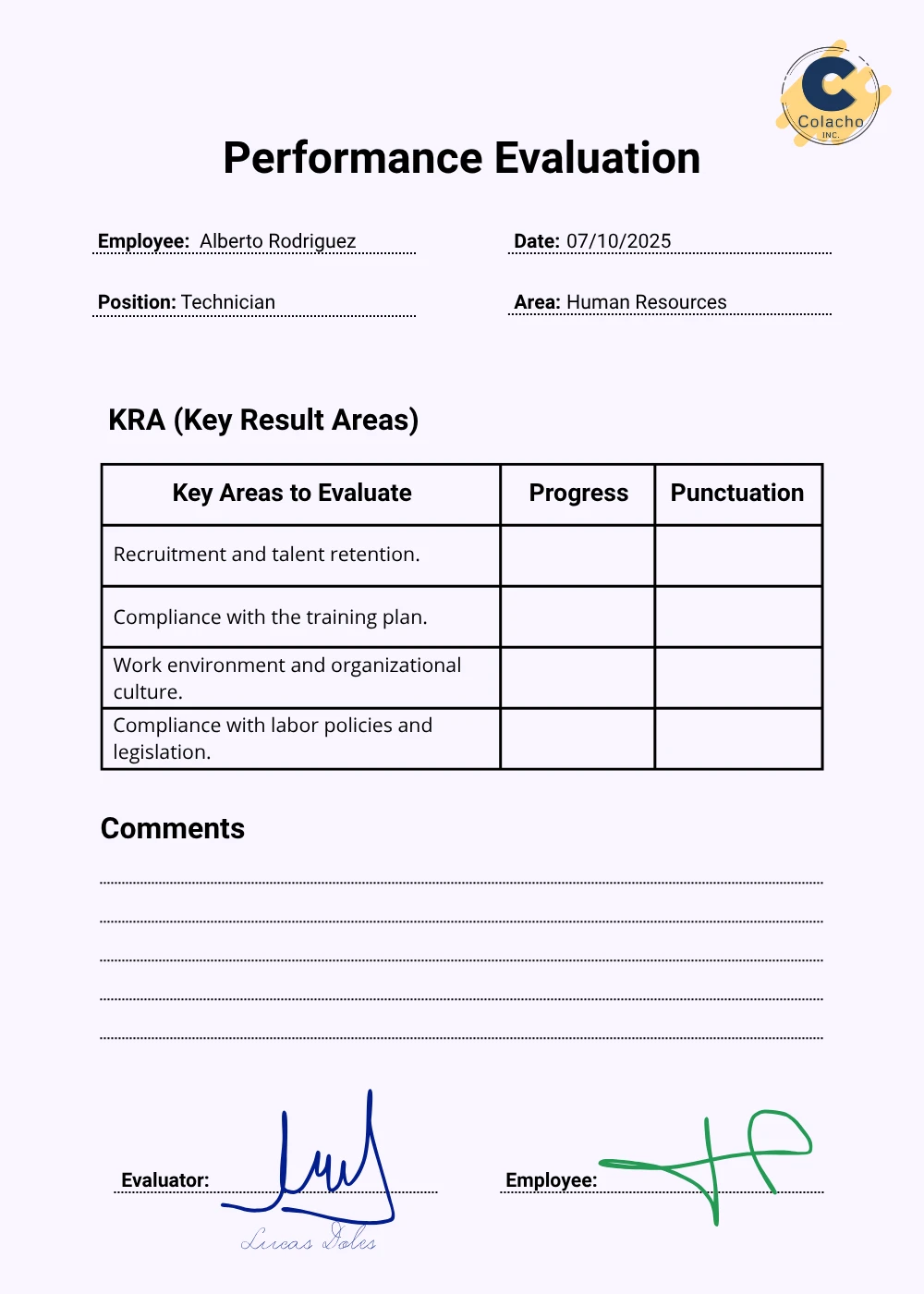
Determine the KRAs (Key Result Areas). They are a list of objectives for each employe, and they will vary by professional profile and experience. Helps each employe understand what is expected of them.
🔔 Advice: Align objectives with the fiscal year.
-
Guidence
Periodic meetings to review progress. It is crucial that we establish a schedule for reviews so that we can monitor progress and correct any deviations if necessary. We must be careful not to overload ourselves with review meetings.
Continuous feedback (informal feedback). Crucial subject for resolving the previous point.
Identifying training needs. It will be vital to anticipate any required training, as this will simplify its planning later on.
-
Evaluation and Review
Formal performance evaluation (forms with objectives, KRAs, metrics, weighting, and final score). Now, it’s time to gather all the performance points we’re going to evaluate.
Employment of evaluation techniques (comparison, scales, 360°, objectives-based, etc.). We must select the evaluation technique that best suits the outcome we are seeking. If necessary, we can combine several techniques. It is not advisable to create a collage, as it could affect the outcome of our evaluation.
Involve managers, peers, and collaborators to ensure objectivity. Bringing different perspectives will help to reduce biases.
-
Rewards and Development
Monetary and non-monetary rewards. We must clearly and transparently establish the incentives or recognition we will award for meeting the objectives.
Career plan and internal promotions. Evaluations not only provide a solid basis for justifying promotions, but also help in developing career plans.
Specific training programs. When we evaluate an employee’s performance, it becomes easier to identify the skills they lack to meet their objectives or will need in the future.
Salary adjustments based on performance and the market.
📊 Performance Evaluation Methods
Let’s continue, by analyzing some of the evaluation methods we can use to measure staff performance.
Types of Evaluation
When starting to evaluate people’s performance, we can do it in two ways:
- Informal => it occurs on a daily basis thru observation and interaction; simply by working together, we can see how the employe performs. That’s why it’s a continuous, hands-on method that encourages immediate feedback. Its disadvantage is that it is subjective and we won’t have a solid basis to support our decisions.
- Formal => here we already use techniques and methods that make it structured, periodic, and data-driven. It allows for comparisons and objective decisions.
Approaches
Let’s explore the different approaches we can apply when evaluating our employes’ performance:
- Per person => personality, behavior, attitudes. We’re going to focus on how the person performs their work. It’s ideal when we also want to identify areas for training.
- By results => achievement of objectives and goals. The simplest approach of all: we’ll simply look to see whether or not the established goals were met.
- Absolute => comparison with a predefined standard. Here we can establish a standard way of doing the work and achieving results, and then compare the employee’s performance to determine whether it was above or below the standard. Everyone will be measured by the same standard.
- Relative => comparison with other employes (ranking). When we have employes performing the same task, we can compare them to identify those who achieve better results than others.
- Global or factored => comprehensive evaluation or evaluation by specific criteria with weighting. We focus on the entirety of the task the employe performs (from start to finish), or we can do it by evaluating specific points.
Main Techniques
Next, we will look at some of the techniques we can use to measure performance. I invite you to discover the one that best suits your needs. And remember that we can use them separately or mix them together.
- Ranking => We rank from best to worst. At the top will be the highest score, and at the bottom the lowest; then the second-highest will be matched against the second-lowest, and so on until all evaluated individuals have been compared. The downside is that it doesn’t visualize the differences in ranking.
- Pairwise comparison => We also conducted a comparison, but the list will be formed according to the number of times each person won in the pairwise comparisons. Here the evaluation criteria will be clearer, since we’ll have to determine and quantify the victory criteria.
- Forced distribution (Gaussian curve) => We’re going to distribute the survey respondents into groups. At the extremes, we’ll have the best and the worst, and in the middle, the most evenly distributed results. It should end up looking like a bell curve. This option is convenient when evaluating a considerable number of people.
- Checklists => We divide the respondents using positive or negative statements to which the interviewer must answer “yes” or “no” to indicate whether they reflect the evaluated person’s performance. The weighting criteria are clearer. It is advisable to use it in companies with large workforces, as the statements would apply to most employes.
- Forced choice => It’s a good method when we want to reduce error. What we need to do is limit the evaluator to choosing between two phrases from predefined groups, with at least two positive and two negative options. The evaluator must choose at least one favorable and one unfavorable statement. The strong point is that the evaluator doesn’t know which phrase awards points. Its only drawback is that it is not an easy method to implement.
- Judgment scales (numerical or verbal) => Certain characteristics are defined to serve as a scale, on which the evaluator then indicates the level of the examinee’s performance. It is therefore crucial that the scales are clear, so that they indicate whether the examinee possesses the characteristic or not. The most commonly used scales are numerical ones or those with words such as “Excellent, Very Good, Good, Fair, or Unsatisfactory”. We must carefully plan the factors and their corresponding scale.
- Written essay => As its name suggests, here we make a free judgment about the person and can add additional information. The biggest drawback is that it can become loaded with prejudice.
- Significant Events (record of achievements and failures) => We establish the evaluation period and, during it, we will note down the positive or negative events that occur. We will separate them into two columns. This process encourages feedback, but it requires us to exercise greater control since we must record the facts.
- Objectives-based evaluation (SMART) => Before starting, it is necessary to agree on the objectives to be evaluated and how the evaluation will be conducted. At the end of the period, the evaluator will assess the extent to which the agreed-upon objectives were achieved. This approach allows us to distinguish between work objectives (related to their task) and development objectives (related to professional growth). The biggest drawback we may encounter is that we will be evaluating whether the objectives are achieved, rather than how they were achieved.
- 360° Feedback => Here we’ll focus on completing a questionnaire that centers on the competencies of the person being evaluated. It will be answered by people close to the individual, allowing us to obtain different points of view, which in turn enables us to gain a new perspective by analyzing them. Here, the person being evaluated can choose who will evaluate them, or we can set the evaluators ourselves.
⚠️ Common errors in evaluation
Let’s look at some of the errors that evaluators can make when assessing the performance of the person being evaluated.
- Halo effect → it’s the most common, and what it does is evaluate everything based on one positive aspect.
- Successive halo → unfairly comparing someone to a very high previous performance. We compare everyone based on the high impression left by a former employe.
- Average judgments → always score in the middle range to “play it safe.”
- Generosity or severity → evaluating everyone too leniently or harshly.
- Systematic → the evaluator has a perception about a quality, which leads them to overvalue or undervalue it.
- Total → occurs when there is a lack of coherence in the evaluation criteria.
- Logical → the evaluator establishes relationships between different criteria, but ends up valuing both equally.
- Memory → relying on past evaluations instead of the present. "If it was bad before, what’s going to change now?".
- Prejudgment → when the evaluator is influenced by personal biases.
💡 The Importance of Feedback
We cannot think about evaluation without considering the feedback we will provide based on the results we obtained from it. Therefore, it is important to keep the following points in mind when conducting the feedback interview with the person being evaluated.
- It must be objective, clear, and data-driven.
- Include space for two-way dialogue (employees can share their perspectives).
- Prevent it from becoming a judgment: see it as a development opportunity.
- The feedback should focus on achievements and possible improvements.
🚀 Impact of good performance management
We cannot think about evaluation without considering the feedback we will provide based on the results we obtained from it. Therefore, it is important to keep the following points in mind when conducting the feedback interview with the person being evaluated.
- Increase the engagement and motivation.
- Improve productivity.
- Reduce employe turnover.
- Foster the organizational culture.
- Ensure the company’s sustainable growth.
🧠 Practical exercises
👉 Exercise 1 - KRA Identification
The following position must be evaluated: Logistics Supervisor.
Define 3 Key Result Areas (KRAs) that should be evaluated and how you would measure them.
👉 Exercise 2 - Rating Scale
Rate the performance of a Marketing Analyst on the following scale:
"Excellent | Very Good | Good | Fair | Unsatisfactory"
Criteria to consider:
- Creativity in campaigns.
- Meeting deadlines.
- Teamwork.
👉 Exercise 3 - Constructive feedback
Imagine that a team member didn’t reach 100% of their objectives, but showed a great deal of commitment. Write an example of positive feedback + a suggestion for improvement.